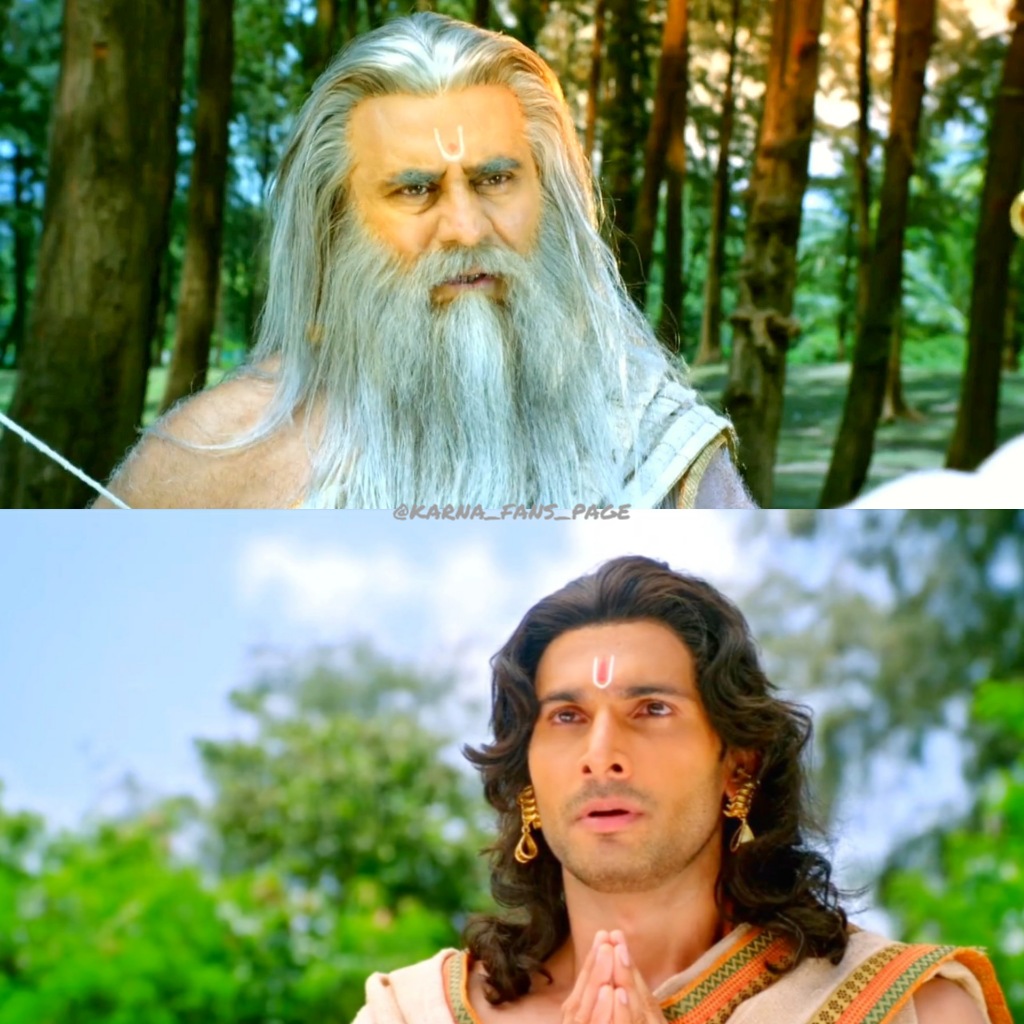
It was to no ordinary guru that Karna was going, but to an Avatara. He had decided to approach Parasurama Bhargava to teach him. Karna had a plan. Being a sutaputra, he was both a brahmana and a kshatriya; and of course, neither of these when it mattered. He knew how Bhargava hated the kshatriyas. A kshatriya had murdered his father Jamadagni and Parasurama had let flow a river of warriors’ blood.
He was calmed now, that his revenge was complete; and he had played no part in the affairs of the world since Rama of Ayodhya had confronted him. Bhargava sat in tapasya to purify himself of the sins of all the killing he had done. But Karna was wise enough and worldly enough by now, to know that Parasurama would never teach a kshatriya. But if he told the master that he was a brahmana— that rarest of brahmanas, who wanted to be an archer—surely, he would not turn him away. And to say he was a brahmana was only half a lie.
After many days, Karna arrived on the tangled slopes of the southern mountain, Mahendra. After climbing some hours, he saw a sequestered tapovana ahead of him. There, under a majestic banyan tree, he saw Bhargava, his eyes shut, like a flame. But he was quiescent now, all his vast energy turned inwards. His heart beating wildly, Karna approached the guru.
Parasurama sat lost to the world. Karna stood with folded hands, not daring to make a sound. At last, the Avatara’s eyes fluttered open and gazed into Karna’s deepest soul. Parasurama said, “Who are you, young man?”
Karna threw himself at Bhargava’s feet and cried, “Lord, I have come to you with my heart full of hope. Please don’t turn me away, you also!”
Parasurama saw the youth was in tears. He said gently, “What is it you want from me, child?”
“Take me as your disciple. I am a brahmana, but I want to be an archer. And no master will have me, saying they teach only kshatriya princes. You are my last resort. If you don’t accept me I will kill myself.”
Parasurama laid his palm on the striking youth’s head, blessing him. “From today, young Brahmana, you are my disciple. I will teach you everything I know. What is your name?”
“Karna.”
Thus began the tutelage of Karna, son of Surya Deva and Kunti, adopted son of Atiratha the suta and his Radha. In many ways, those were the best days of his life. Holding a bow in his hands finally was like being born into his dreams. The cruel world paled and all the times he had been called sutaputra. Karna was absorbed in learning from his profound and, he discovered, kindly master. He even forgot the woman of his dreams and she never came to haunt him in Parasurama’s asrama.
The guru discovered this sishya was an extraordinary pupil. He had never seen a young man as gifted as Karna; be it archery or the Vedas, the youth was completely devoted to whatever he studied. He drank thirstily at the profound font his master was.
Yet Karna thought of the archer’s martial knowledge rather differently from what most young men did. To him that knowledge would make him powerful; power would bring fame; and fame meant everything to him, it meant honor to the sutaputra. What else was worth living for in this harsh world?
Came the day, after three years, when Parasurama said to his brilliant disciple, “The time has come for you to acquire the final gyana that any archer can have.”
“What will I learn, master?” cried Karna, loving every challenge.
“The devastras.”
One winter’s morning, having bathed in the frothy stream, Karna sat before his guru just as the rising sun lit the horizon. Parasurama intoned the mantras that invoke the astras of the Gods of light. Suddenly the mountain air was full of awesome spirits bearing unearthly gifts of weapons. The astras appeared, phosphorescent before the master and his pupil. When Karna chanted their mantras, those weapons flashed into his body and then on were his to command. Karna acquired all the astras that could be had in this world, even the brahmastra and the bhargavastra.
Parasurama embraced Karna. “It seems the Gods have blessed you; you are the best sishya I ever had. And what pleases me even more than your genius are your humility, your affection and, most of all, your honesty.
You are a master of the devastras now, an invincible warrior. I have one final piece of advice for you, which by itself is worth everything else you have learnt from me. You must use your powers only in the service of dharma. The other way, the path of sin, leads to death.”
The sun was overhead. Parasurama said, “I am tired. Go back to the asrama and fetch a roll of deerskin. I want to fall asleep here, beneath this tree.”
“Why wait until I fetch the skin? You can use my lap for a pillow.”
Bhargava patted Karna’s cheek. The sishya sat cross-legged under the spreading banyan and his guru lay with his head in his lap. In no time, he was asleep, snoring softly. Karna also shut his eyes and was lost in anxious thoughts. His master had called him honest. But was he that? Hadn’t he lied about being a brahmana? Wasn’t his more a thief’s way, than an honest man’s? Then he thought, ‘I lied only to learn from my guru. I have served him faithfully and been a deserving pupil. He himself said I am the best sishya he ever taught; there is no sin in what I did.’ But these tangled anxieties gave Karna no peace.
Suddenly he felt a searing pain in his leg and almost cried out. He dare not move lest he wake his master. He saw a strange insect had crawled on to his thigh. It was as big as his thumb and looked like a tiny wild boar. The creature had tusks and needle-sharp teeth, with both of which it now gouged out good mouthfuls of his flesh and champed on the raw meat and swilled the blood.
Karna was in agony. But he did not stir. His guru’s arms lay across his own hands, so he could not move these either. Gritting his teeth, Karna sat on. Finally the blood from the insect’s feast flowed on to Parasurama’s face and he awoke and sat up.
“Where did this blood come from?”
“An insect bit me,” said Karna casually, plucking the offending creature from his skin and throwing it down.
Bhargava saw the wound in his pupil’s thigh. He saw the black insect, covered in Karna’s blood. Parasurama stared hard at Karna. Very softly, he said, “That thing tore at your thigh for a long time. The pain must have been intolerable, but you did not move.”
“I would have disturbed you if I moved. I paid no mind to the pain.”
“Pain?” Parasurama’s eyes had begun to smolder dangerously. “It must have been agony. But you didn’t move.”
“I didn’t want to wake you,” repeated Karna, growing confused at his master’s accusing tone. He thought his guru would be pleased by his devotion.
But Parasurama was on his feet, his face a picture of suspicion. “You told me you are a brahmana, but no brahmana on earth could bear such pain. You lied to me, Karna; you are a kshatriya, aren’t you? Tell me the truth!”
Karna stood shaking before his master. Parasurama breathed, “I have given the devastras to a lying kshatriya. For three years I kept you with me, taught you everything I know and it was all a lie!”
Karna fell at his feet. “I am a sutaputra. I had to become an archer and no one would teach me. Forgive me, my lord. I am not a brahmana, but I am not a kshatriya either. The wise say that true knowledge knows neither caste nor creed. Be merciful, Guru, I couldn’t bear it if you were angry with me.”
The rishis are masters of their emotions; but at times, anger overwhelms the strongest of them. Parasurama was no exception. He was livid, blind with rage. Forgotten were Karna’s humility, his devotion, his brilliance; all Bhargava saw was a betrayal, an aggression against himself, a violation.
Parasurama was an Avatara; he had sat for centuries in dhyana. Yet now fate stirred him more than he could bear. Bhargava cursed Karna: “One day, when you invoke the brahmastra, when you need it for your very life, you will forget its mantra. Why, that day you will forget the mantras of all the astras I have taught you!”
Karna knelt, aghast, before his master. “Oh, my lord, do I deserve this? You are too harsh.”
As soon as he had cursed Karna, Parasurama’s rage seemed to cool. He said more gently, “I cannot take back my curse. But it was seeking fame that you came here, for fame that you lied to me. Sutaputra, I bless you now that your name will be a legend across the earth and men will say you were the greatest archer who ever lived.”
For a moment more, the guru stared at his stricken sishya. Then he turned and walked away from him forever. For a long time Karna lay hugging himself, sobbing. Then, slowly, he rose and went down to the stream and washed his face. He bathed the wound in his thigh, where the fateful insect had gorged. Still moaning now and again, he made his way down the mountain.
Reference – The Mahabharata: A Modern Rendering, Vol 1 THIRTY-THREE
Karna finds a master (not authentic )
❤️ Darshan ❤️

 KARNA REAL HERO OF MAHABHARAT